Choosing Kitchen Colour From Sample Doors
Cabinet colour is decided by three things a photograph cannot show: the direction the window faces, the undertone in the floor and the hour the kitchen is actually used. CasaBuilt's 16-door sample range splits into seven colour families, with five whites and three grays carrying most of the choice, and each door costs $9.99 with the fee refundable on a cabinet purchase. The door is cheap; the repaint is not, which is why the sample matters more than the shortlist.

Key takeaways
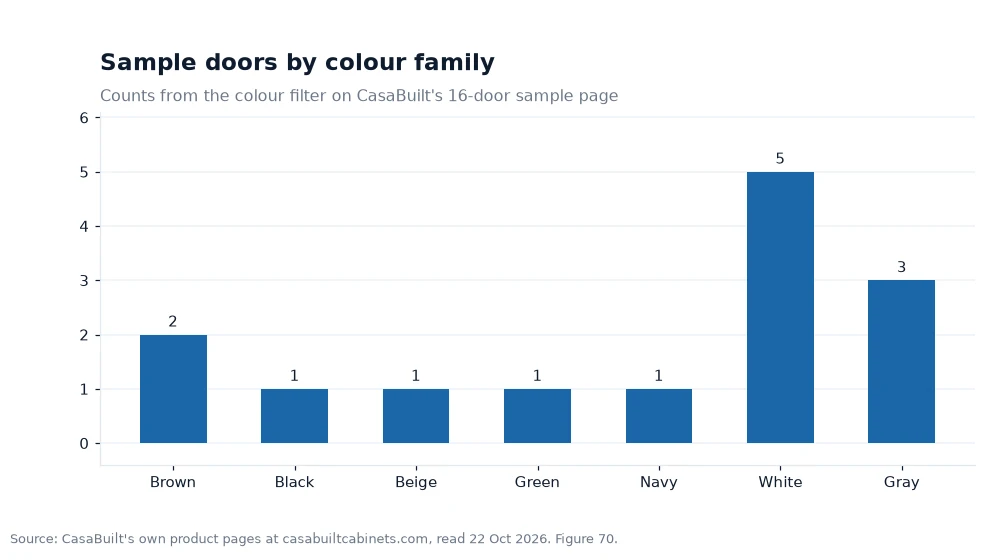
- The sample range covers seven colour families: 5 white, 3 gray, 2 brown, 1 black, 1 beige, 1 green and 1 navy.
- White doors are 31.25% of the range and gray 18.75%, so most of the choice sits in the neutrals.
- Each door is $9.99 and refundable with a cabinet purchase, so a three-door test costs $29.97 up front.
- A door judged at noon can fail at eight in the evening under the room's own lights.
Start with the window, not the shortlist
A north-facing kitchen receives cool, indirect light for most of the day. A warm white door reads gray against it, and a gray door reads closer to blue than the sample suggested. A south-facing kitchen does the opposite: strong light lifts warm whites toward cream and can make a mid-gray look lighter than its name. Neither room is a problem. They are different rooms, and the same door cannot be the right answer in both.
The practical move is to judge the door in the room before judging it against other doors. Set the sample on the counter at the position where the cabinet will hang and step back three paces. Then look at it from the doorway, because that is the view a guest gets and the view the household sees every time it walks in. Only after that should a second door come out of the box.
Artificial light is the second variable and the one most buyers forget. A kitchen used from six in the morning to eight at night lives under two lighting conditions, and a cool white under-cabinet strip will push a warm finish toward yellow. Turn the lights on and repeat the check. If the door looks wrong under the lights the household actually uses, the door is wrong.
The seven colour families in the range
The published sample page groups the 16 doors by colour. Five are white, three gray, two brown, and there is one each of black, beige, green and navy. The distribution is not even, and that unevenness is useful information: it tells a buyer where the range is deep and where a colour exists as a single option.
| Colour family | Doors | Share of 16 | Where it usually lands |
|---|---|---|---|
| White | 5 | 31.25% | Small kitchens, north light, resale-minded builds |
| Gray | 3 | 18.75% | Open plans, cool floors, industrial hardware |
| Brown | 2 | 12.5% | Wood-tone looks, warm floors, older housing stock |
| Black | 1 | 6.25% | Islands, accent runs, high-contrast schemes |
| Beige | 1 | 6.25% | Warm neutrals, cream stone, soft afternoon light |
| Green | 1 | 6.25% | Painted-cabinet looks with brass or bronze hardware |
| Navy | 1 | 6.25% | Lower cabinets under pale uppers, darker rooms |
Read the shares before ordering. If a household wants a green kitchen, the range offers one door, so the decision is quick but the fallback is thin. If the plan is a white kitchen, five doors must be compared against each other, and the differences between them are subtle enough that one door is not a fair test. The White Shaker listing is the place to start that comparison, since it carries the full specification beside the price. The depth of the white group is exactly why the neutral decision takes longer than the bold one.
Matching the door to the floor
Floor and cabinet are the two largest surfaces in most kitchens, and they compete for the same light. A warm oak floor pulls a cool gray cabinet toward green; a gray tile floor drains warmth out of a cream door. The reliable method is to put the sample on the floor rather than on the counter, because the reflection off the floor is part of what the eye reads.
Three floor types cover most of the problem. A warm wood floor wants either a clearly warm white or a deliberately cool one; the mid-tones are where collisions happen. A gray or concrete-look floor tolerates gray cabinets if the undertones match, and looks unresolved if one reads blue and the other reads green. A pale tile floor is the most forgiving surface in the house and will let a darker cabinet carry the room.
Countertops complicate it again, but they are easier to change than cabinets. If the door works against the floor and the wall color, the countertop can be chosen to bridge the two. If the door fails against the floor, no worktop will rescue it. That is the order of decisions, and it is why the floor check comes before the worktop check.
Testing at the hour the kitchen is used
Most colour mistakes happen in the first ten minutes of a sample visit, under whatever light happens to be on. The published free sample option costs $9.99 and returns the fee with a cabinet purchase, so there is no reason to rush the test. Live with the door for a few days and look at it at breakfast and again after dark.
Keep a written note on the back of each door: the profile, the colour family and the room it was judged in. When three doors are in play, the notes are what stops a household from agreeing on one finish at the table and ordering another a week later. Photograph the winner in place, with the floor and a section of wall in the frame, so the order can be checked against the decision.
If the kitchen is open to a living room, repeat the check from the sofa. A cabinet colour that works in the kitchen but fights the adjacent wall paint will be visible from the sofa every evening. The door is portable; the wall is not.
Worked example: counting the range
The chart lists the families in order: Brown 2, Black 1, Beige 1, Green 1, Navy 1, White 5 and Gray 3. Add them: 2 + 1 + 1 + 1 + 1 + 5 + 3 = 16, matching the published total. As shares of 16, Brown is 12.5%, and Black, Beige, Green and Navy are 6.25% each. White is 31.25% and Gray is 18.75%.
Group the neutrals and the numbers get useful. White, Gray and Beige together are 5 + 3 + 1 = 9 doors, or 56.25% of the range, which is why most kitchen decisions end in a neutral. The three darkest families, Black, Green and Navy, total 3 doors, or 18.75%. Pricing the whole set at $9.99 gives 16 x $9.99 = $159.84; the five whites alone are 5 x $9.99 = $49.95, and the three grays are $29.97. A household comparing five whites and three grays is looking at $79.92 of doors, all of it refundable with a cabinet purchase.
Frequently asked questions
How many colour samples should I compare at once?
Three is the practical maximum: one leading candidate and two alternatives from the same family. The range holds five whites and three grays, so a white comparison can legitimately use four or five doors at $9.99 each. Beyond that the eye starts judging the doors against each other rather than against the room, which is the wrong test.
Does the sample fee come back if I order cabinets later?
Yes, the published term is that the $9.99 sample price is refundable with a cabinet purchase. The refund follows the cabinet order rather than the sample delivery, so keep the receipt with the order details. A household that samples five whites at $49.95 recovers the full amount when the kitchen is bought.
What if the kitchen has almost no natural light?
Judge the door under the room's own artificial light and lean toward the lighter end of the range, where five whites and one beige are available. A dark cabinet in a low-light room absorbs what little light there is, while a white door reflects it. Test the leading candidate at night as well as during the day before ordering.
Order three doors and decide in the room
Pick the leading candidate, the nearest alternative and one from a different family, then judge all three on the floor rather than the counter. Note the profile and the light conditions on the back of each door, and keep the receipts together so the refund is a single transaction later. The five whites are there to be compared; the single green and navy doors are there to answer a specific question.
Colour is the one part of a kitchen that cannot be corrected with a hinge adjustment. Spending $29.97 on three doors is the cheapest insurance in the project, and the fee comes back when the cabinets do.
Figures quoted here come from the manufacturer's own website, read 22 Oct 2026[1].